Chapter 16: The Beast Economic System – Controlled Commerce and Coerced Compliance
The Bible gives one of the clearest—and most sobering—descriptions of the end‑time world system in Revelation 13. While many focus on the "mark," few examine the larger structure surrounding it: a fully controlled economic system designed to enforce loyalty, restrict freedom, and compel worship.
In this chapter, we explore how the beast uses commerce as a weapon, how technology makes this possible, and how believers can discern the times.
The Scriptural Foundation of Economic Control
The Word of God is explicit:
Revelation 13:16-17:
"And he causeth all, both small and great, rich and poor, free and bond, to receive a mark in their right hand, or in their foreheads: And that no man might buy or sell, save he that had the mark, or the name of the beast, or the number of his name."
Economic access becomes contingent upon allegiance. This is not merely a financial policy. It is a spiritual test. Buying and selling touch the most basic needs of human life: food, shelter, medicine, work, and survival. By controlling commerce, the beast system gains leverage over the entire population.
Notice the comprehensiveness: "all, both small and great, rich and poor, free and bond." No one is exempt. The wealthy cannot buy their way out. The poor cannot hide in obscurity. The powerful cannot leverage their status. The enslaved cannot claim they have nothing left to lose. Every social class, every economic tier, every demographic will face the same choice: take the mark and participate in the economy, or refuse the mark and be locked out of all commercial activity.
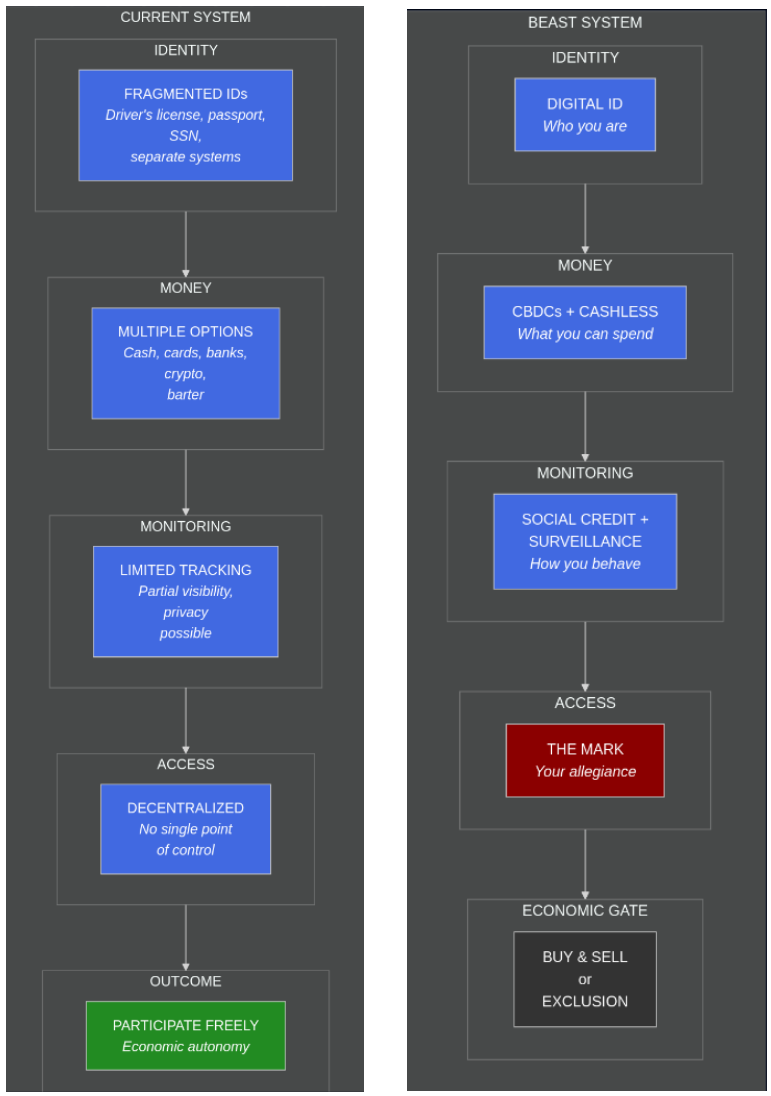
This is total control. Not partial. Not selective. Total. And it is enforceable precisely because technology now makes it possible to track every transaction, monitor every person, and shut down access with the press of a button. What was once prophetic mystery is now technical reality.
The Long Road to a Cashless World
For thousands of years, economies operated through barter, metals, coinage, and paper money. All of these offered privacy, autonomy, and independence. A man could work for wages, receive payment in coin, and spend that coin without anyone tracking where it came from or where it went. His transaction was between him and the merchant. No intermediary. No record. No surveillance.
But digital currency changes everything. Whether via credit cards, online payments, mobile wallets, or QR codes, every digital transaction creates a permanent record. The intermediary (bank, payment processor, government) sees everything. Knows everything. Records everything. And can control everything.
Cash is being systematically eliminated. Banks penalize cash deposits. Merchants refuse cash payments. Governments limit cash transactions above certain thresholds. The justification is always the same: convenience, safety, efficiency. But the result is total visibility. No transaction is private. No purchase is anonymous. And once cash is gone, there is no alternative. You either use the digital system, or you do not participate in the economy at all.
Proverbs 22:7:
"The rich ruleth over the poor, and the borrower is servant to the lender."
In a digital economy, the entire population becomes the borrower. Not borrowing money necessarily, but borrowing access. Access to the payment system. Access to banking infrastructure. Access to the ability to buy and sell. And the lender, the system that grants or denies that access, becomes the master. Every purchase becomes a data point. Every person becomes a profile. And every profile can be restricted, frozen, or deleted based on behavior, belief, or allegiance.
Digital ID: The Gatekeeper of Access
A controlled economic system requires one critical component: identification. You cannot restrict who buys and sells unless you first know who everyone is. And you cannot link purchasing power to allegiance unless identity is unified, digital, and centrally controlled.
This is why digital ID systems are spreading worldwide. India's Aadhaar system has enrolled over 1.3 billion people, linking biometric data (fingerprints, iris scans) to a single national ID number required for banking, government services, and even mobile phone access. The European Union is rolling out a digital identity wallet that will store credentials, health records, payment information, and travel documents in one centralized app. The World Health Organization is developing a global digital health certificate system that tracks vaccination status, test results, and medical history across borders.
These systems merge everything into one profile: biometric data, medical records, banking access, social benefits, travel permissions, employment status, criminal history, and purchasing behavior. Your identity becomes your passport, your wallet, your medical file, and your permission slip all in one. Convenient, yes. But also completely controlled.
Under such a system, identity is no longer who you are. It is what the system allows you to be. If the system decides you are non-compliant, unvaccinated, politically suspect, or ideologically dangerous, it can revoke your identity. Not kill you. Just erase your ability to function. You still exist. But you cannot work. You cannot travel. You cannot buy food. You cannot access your own money. You become a non-person, alive but excluded, breathing but banned from participation in civilized society.
Psalm 118:8:
"It is better to trust in the Lord than to put confidence in man."
But the world is placing total confidence in digital identity. The more society trusts these systems, the more vulnerable it becomes to forced compliance. And once identity is digital, centralized, and mandatory, the infrastructure for the mark of the beast is complete. All that remains is to flip the switch.
The Rise of Central Bank Digital Currencies (CBDCs)
CBDCs represent the most significant economic shift in modern history. They are not merely a digital version of existing currency. They are programmable money, controlled money, money that can be restricted, monitored, and manipulated in ways physical cash never could.
Unlike cryptocurrency, which was built on decentralization and privacy, CBDCs are the opposite. They are issued by governments, controlled by central banks, and designed for total visibility and total control. China has already launched its digital yuan, piloting it in major cities and requiring its use for certain government transactions. Nigeria rolled out the eNaira, attempting to replace cash with a centrally controlled digital currency. The European Central Bank is developing the digital euro. The Federal Reserve is researching a digital dollar. Over 100 countries are exploring or implementing CBDC systems.
The key feature of CBDCs is programmability. Unlike cash, which is neutral (a dollar is a dollar, no matter who holds it or how they spend it), a CBDC can be programmed with rules. It can be restricted to certain purchases. It can expire if not spent within a certain timeframe, forcing consumption. It can be geofenced, preventing you from spending it outside approved locations. It can be frozen instantly if you are deemed non-compliant. It can be taxed automatically before you even receive it. And it can be monitored continuously, every transaction recorded, analyzed, and flagged for suspicious activity.
This allows full-spectrum control: restricting purchases based on social credit scores, denying access based on political views or religious affiliation, enforcing carbon limits by blocking purchases that exceed your allowed environmental footprint, eliminating cash savings by imposing negative interest rates that drain your balance over time, and monitoring all economic activity in real time with no possibility of privacy or anonymity.
Consider the implications. If your digital currency can expire, you cannot save for the future. If it can be geofenced, you cannot move freely. If it can be restricted, you cannot buy what you need. If it can be frozen, you have no financial security. And if every transaction is monitored, you have no freedom. You are entirely dependent on the system. And the system can shut you down at any moment, for any reason, without appeal, without recourse, without mercy.
A CBDC makes Revelation 13 technologically feasible. Total economic control becomes a function of code. The mark of the beast does not require a physical implant or tattoo, though it may include that. The mark can be as simple as a digital identity linked to a programmable currency. Take the mark, accept the system, pledge allegiance, and your money works. Refuse, and your money stops. You cannot buy. You cannot sell. You are locked out.
Social Credit: Conditioning Through Compliance
Social credit systems are already operational in multiple nations, and they function exactly as Revelation 13 describes: compliance grants access, non-compliance results in exclusion.
China's Social Credit System is the most developed example. Citizens are monitored through surveillance cameras equipped with facial recognition, internet activity tracking, financial transactions, and reports from neighbors and employers. The system assigns scores based on behavior. Positive actions (paying bills on time, donating to approved causes, praising the government online) raise your score. Negative actions (jaywalking, posting criticism of the Communist Party, associating with low-scoring individuals, attending unapproved religious gatherings) lower your score.
A low score results in tangible punishment. You cannot buy plane or train tickets. You cannot enroll your children in private schools. You cannot get loans. You cannot rent apartments in desirable areas. You cannot get certain jobs. You are publicly shamed on billboards and websites listing "dishonest persons." You become a second-class citizen, not through law, but through algorithm. And there is no trial, no defense, no appeal. The system decides, and the system enforces.
But social credit is not limited to authoritarian regimes. The West has its own version: Environmental, Social, and Governance (ESG) scores. Corporations are rated on their compliance with climate goals, diversity quotas, and social justice initiatives. Banks use ESG scores to determine who receives loans. Investment firms use them to decide which companies get funding. And increasingly, individuals are being scored as well. Carbon footprint tracking. Vaccine passports. Hate speech violations. Misinformation flags. All of these create a profile, a score, a measure of compliance.
This mirrors the beast system precisely: obedience equals access; disobedience equals starvation. Comply, and the system provides. Resist, and the system withholds. It is coercion disguised as incentive. It is tyranny disguised as social responsibility.
Amos 8:4-6:
"Hear this, O ye that swallow up the needy, even to make the poor of the land to fail, Saying, When will the new moon be gone, that we may sell corn? and the sabbath, that we may set forth wheat, making the ephah small, and the shekel great, and falsifying the balances by deceit? That we may buy the poor for silver, and the needy for a pair of shoes; yea, and sell the refuse of the wheat?"
The powerful manipulate the economy to control the vulnerable. The poor are made to fail by design. The system makes survival itself contingent upon submission. And when economic access becomes the weapon, the vulnerable suffer first. But eventually, the system expands. The net widens. And all are caught. Rich and poor. Free and bond. All must comply, or all will starve.
Economic Rituals: Worship Through Transactions
The beast system merges economics with spirituality. In Revelation, economic participation becomes an act of worship. This is not metaphorical. The text explicitly links the mark, the economy, and worship together.
Revelation 13:15-17:
"And he had power to give life unto the image of the beast, that the image of the beast should both speak, and cause that as many as would not worship the image of the beast should be killed. And he causeth all, both small and great, rich and poor, free and bond, to receive a mark in their right hand, or in their foreheads: And that no man might buy or sell, save he that had the mark, or the name of the beast, or the number of his name."
Notice the sequence: worship the image, or be killed. Take the mark, or be excluded from commerce. The two are connected. Economic participation requires allegiance. Buying and selling become acts of submission to the beast. Every transaction becomes a ritual, a repeated affirmation that you belong to the system, that you serve the beast, that you have chosen mammon over God.
This is not new. Rome required citizens to burn incense to the emperor as a god. Refusal was treason, punishable by death. Roman coins bore the emperor's image and titles proclaiming his divinity: "Divine Augustus," "Son of God," "Savior of the World." To use Roman currency was to participate in a system that declared Caesar as lord. Early Christians understood this. They knew that handling coins marked with blasphemous titles was spiritually compromising. They knew that participating in the imperial economy was, in some sense, bowing to the empire. Yet they had no choice. They needed to eat. They needed to survive. And so they used the coins, but they did not pledge their hearts.
The mark of the beast removes even that option. It is not passive participation. It is active allegiance. You cannot simply use the currency while internally rejecting the system. The mark requires consent. It requires you to take it willingly, to accept it in your hand or forehead, to identify yourself as belonging to the beast. And once you take it, there is no neutrality. You have worshiped. You have pledged. You have chosen.
Matthew 6:24:
"No man can serve two masters: for either he will hate the one, and love the other; or else he will hold to the one, and despise the other. Ye cannot serve God and mammon."
The final choice becomes stark: serve God and lose economic privilege, or serve the beast and gain temporary provision. There is no middle ground. No compromise. No way to quietly navigate both kingdoms. You will serve one or the other. And your choice will be revealed not in words, but in action. In whether you take the mark. In whether you bow. In whether you participate in the economy of the beast or trust in the provision of God.
Global Crises as Catalysts
Major shifts in economic control rarely happen during times of peace and prosperity. They happen during crises, when fear is high, when people are desperate, when the population is willing to surrender freedom in exchange for safety.
Pandemics lockdown economies and condition populations to accept digital health passports, contact tracing, and movement restrictions. Wars justify rationing, price controls, and nationalization of industries. Recessions create dependency on government aid, universal basic income, and centralized relief programs. Cyberattacks on banking systems provide the excuse to eliminate cash and mandate centralized digital currency for "security." Natural disasters require emergency powers, supply chain control, and resource allocation managed by the state.
Each crisis becomes a justification for centralization. The language is always the same: "To prevent fraud, we must track all transactions." "To keep you safe, we must monitor your movements." "To ensure stability, we must control the money supply." "To stop terrorism, we must know who is buying what." "To save the planet, we must limit your consumption." Every crisis, every emergency, every disaster becomes an opportunity to tighten control, to expand surveillance, to normalize what would have been unthinkable in calmer times.
But behind these justifications lies a spiritual agenda: consolidation. The goal is not safety. It is control. The goal is not stability. It is dependency. The goal is not security. It is submission. And every crisis moves the world one step closer to a unified economic system where all must participate, all must comply, and all must worship the beast or starve.
2 Corinthians 2:11:
"Lest Satan should get an advantage of us: for we are not ignorant of his devices."
The faithful must not be deceived by manufactured urgency. We must recognize that crises are exploited, and often created, to advance an agenda. The Hegelian dialectic: create the problem, provoke the reaction, offer the solution. And the solution is always more power, more control, more centralization. The enemy does not waste a crisis. Neither should we. We must see through the fear, discern the agenda, and refuse to surrender what God has given us in exchange for false promises of safety.
The Economic Mark as Covenant
The mark is described as being placed "in their right hand, or in their foreheads." This is not accidental symbolism. It is precise spiritual language.
The hand represents action, labor, work, what you do with your life. The forehead represents thought, identity, allegiance, what you believe and who you serve. The beast demands control over both. Not just your compliance, but your conviction. Not just your participation, but your worship. The mark binds you to the system in body and soul.
Consider what taking the mark means. If it involves genetic alteration, as discussed in Chapter 14, then it changes your DNA, defacing the image of God within you. If it involves brain-machine interface, as discussed in Chapter 13, then it merges your consciousness with the system, making you part-human, part-machine, no longer fully the creation God designed. If it involves a biometric implant or tattoo, it marks your flesh permanently, a visible sign that you belong to the beast, not to God.
Revelation 14:9-11:
"And the third angel followed them, saying with a loud voice, If any man worship the beast and his image, and receive his mark in his forehead, or in his hand, The same shall drink of the wine of the wrath of God, which is poured out without mixture into the cup of his indignation; and he shall be tormented with fire and brimstone in the presence of the holy angels, and in the presence of the Lamb: And the smoke of their torment ascendeth up for ever and ever: and they have no rest day nor night, who worship the beast and his image, and whosoever receiveth the mark of his name."
This is not symbolic judgment. This is literal, eternal, irreversible consequence. Those who take the mark face the undiluted wrath of God. No mercy. No repentance. No second chance. Why? Because the mark is not merely economic participation. It is covenant. It is a binding agreement, a pledge of allegiance, a choice that cannot be undone.
The mark is a counterfeit seal, competing with the seal of God.
Revelation 7:3:
"Saying, Hurt not the earth, neither the sea, nor the trees, till we have sealed the servants of our God in their foreheads."
God seals His servants in their foreheads. The beast copies this. God marks His own with the Holy Spirit, an invisible seal that identifies them as belonging to Him. The beast marks his own with a visible, physical mark that identifies them as belonging to the system. Both marks are permanent. Both marks signify ownership. Both marks determine destiny.
You cannot take both. You cannot serve both. You will be sealed by God or marked by the beast. And your choice will determine not only your access to the economy, but your access to eternity.
Preparing for the Beast Economy
Believers must prepare spiritually and practically, but preparation without faith is merely survivalism. We do not prepare because we fear the future. We prepare because we are wise, because we are prudent, and because we trust that God will provide even when the system fails.
Spiritual preparation comes first. Cultivate faith that God provides. Study the Scriptures. Know the accounts of God's provision for His people. Elijah fed by ravens. Israel sustained by manna. The widow's oil that did not run out. Jesus feeding five thousand with five loaves and two fish. God does not need the beast's economy to feed His children. He can provide supernaturally, miraculously, abundantly, even when all human systems collapse.
Matthew 6:31-33:
"Therefore take no thought, saying, What shall we eat? or, What shall we drink? or, Wherewithal shall we be clothed? (For after all these things do the Gentiles seek:) for your heavenly Father knoweth that ye have need of all these things. But seek ye first the kingdom of God, and his righteousness; and all these things shall be added unto you."
This is not passivity. It is priority. Seek God first. Trust Him first. And then take practical steps, not out of fear, but out of wisdom.
Minimize dependency on centralized systems. The more you rely on the grid, the banks, the digital infrastructure, the more vulnerable you are when access is restricted. Learn to live with less. Simplify. Reduce debt. Eliminate subscriptions. Break the addiction to convenience. The system conditions you to depend on it. Break that conditioning before the system uses that dependency as leverage.
Build local networks and communities. Know your neighbors. Build relationships with other believers. Create systems of mutual aid that do not rely on digital transactions. Barter. Trade. Share. The early church practiced communal living, sharing resources so that none had need. This was not socialism. It was voluntary, Spirit-led generosity among believers. When the system locks you out, your community may be all you have. Invest in it now.
Learn skills that transcend digital infrastructure. Can you grow food? Can you preserve food? Can you repair things? Can you build things? Can you provide medical care? Can you teach? Can you lead? The digital economy makes everyone dependent on specialists, on supply chains, on just-in-time delivery. But when those systems fail, practical skills become invaluable. Learn them. Teach them to your children. Do not let your family become so dependent on the system that they cannot survive without it.
Store what is necessary without hoarding. Proverbs 6:6-8 says, "Go to the ant, thou sluggard; consider her ways, and be wise: Which having no guide, overseer, or ruler, Provideth her meat in the summer, and gathereth her food in the harvest." The ant prepares. The ant stores. This is wisdom, not fear. But hoarding is different. Hoarding is greed, anxiety, the refusal to trust God and share with others. Store what you need. Prepare for hardship. But do not hoard out of fear or selfishness. And be willing to share what you have stored when God calls you to.
But above all, cultivate faith. Fear cannot guide preparation. Faith must. Trust that God is sovereign. Trust that He knows what you need. Trust that He will provide. And if He calls you to endure hardship, to go hungry, to suffer for His name, trust that even that is part of His plan and that your reward in heaven is greater than any provision on earth.
Hebrews 11:37-38:
"They were stoned, they were sawn asunder, were tempted, were slain with the sword: they wandered about in sheepskins and goatskins; being destitute, afflicted, tormented; (Of whom the world was not worthy:) they wandered in deserts, and in mountains, and in dens and caves of the earth."
The faithful have always suffered. They have always been excluded. They have always been hunted. And yet they remained faithful. They did not take the mark. They did not bow. They did not compromise. And God counted them worthy. The world was not worthy of them. Neither will the world be worthy of you if you refuse the mark. But heaven will receive you. And that is all that matters.
Summary
The beast economic system is the culmination of centuries of centralization. Through digital ID systems, programmable currencies, social credit scoring, and manufactured crises, the world is being conditioned to accept controlled commerce as normal, necessary, and inevitable.
But Scripture warns that this system will require more than compliance. It will require allegiance. Economic participation will become an act of worship. The mark will become a covenant, a binding pledge that determines not only your access to food and shelter, but your eternal destiny.
Revelation 13:16-17 is no longer prophecy waiting to be fulfilled. It is infrastructure already being built. The technology exists. The systems are operational. The legal frameworks are in place. All that remains is the crisis that will justify their full implementation, and the figure who will demand the world's worship in exchange for economic survival.
The faithful must discern the times and stand firm. We must prepare practically, but trust spiritually. We must reduce our dependency on the beast's system, but recognize that ultimate provision comes from God alone. We must build communities of believers who will support one another when the system locks us out. We must teach our children skills, wisdom, and faith so they are not enslaved by convenience and comfort. And we must settle in our hearts now, before the crisis comes, that we will not take the mark. No matter the cost. No matter the suffering. No matter what.
The God who fed Elijah by ravens will feed you. The God who sustained Israel with manna will sustain you. The God who multiplied loaves and fish will provide for you. Trust Him. Obey Him. And when the beast demands your worship in exchange for bread, refuse. For man does not live by bread alone, but by every word that proceeds from the mouth of God.
Revelation 14:12:
"Here is the patience of the saints: here are they that keep the commandments of God, and the faith of Jesus."
Patience. Endurance. Faith. These are the marks of the saints in the final hour. Not wealth. Not security. Not survival. But faithfulness. And that faithfulness, though it may cost you everything in this world, will gain you everything in the world to come.
Next: The economic system does not impose itself during times of peace and prosperity. It requires crises to justify its expansion. We will examine how the beast system manufactures chaos, exploits disasters, and uses fear to condition populations into accepting control. From wars and pandemics to economic collapses and environmental emergencies, every crisis follows the same pattern: create the problem, provoke the reaction, offer the solution. And the solution is always the same: more power, more surveillance, more centralization, and more control.