Chapter 2: Biblical Cosmology vs. the Heliocentric Model
Two worldviews stand in absolute opposition. One begins with Scripture. The other begins with speculation. One sees the earth as central, created, and purposeful. The other sees it as peripheral, accidental, and meaningless. These worldviews are not compatible. They are not simply different interpretations of the same evidence. They are mutually exclusive paradigms, and the one you choose determines the direction of your life.
Two Irreconcilable Worldviews
The Biblical model of the cosmos is clear and specific. The earth is fixed and immovable. Above it is a firmament—a solid structure separating the waters above from the earth below. The sun, moon, and stars are placed in this firmament, not beyond it. The firmament itself is called Heaven. God's throne sits above this structure, and His gaze is ever upon the earth.
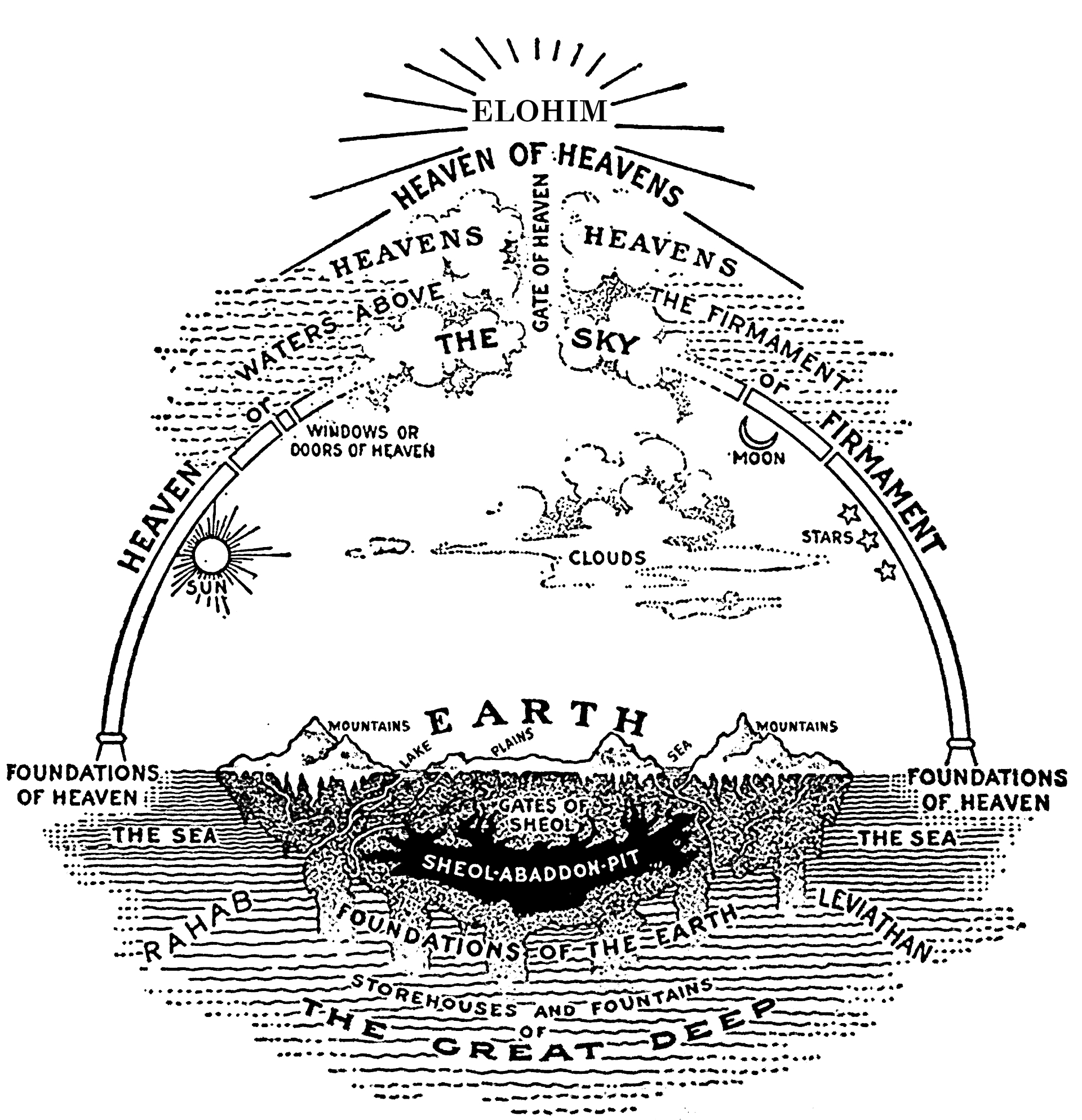
Contrast this with the heliocentric model. In this model, the sun is the center, and the earth is just one of many planets orbiting it. The cosmos is infinite. Space is a vacuum. The stars are distant suns, millions of light-years away. The earth spins at roughly 1,000 miles per hour at the equator, orbits the sun at 66,600 miles per hour, and the solar system itself is moving through the galaxy at a staggering 500,000 miles per hour.
These models are not reconcilable. Either the earth is fixed, or it is spinning. Either the sun moves through the heavens, or the earth orbits the sun. Either the stars are small lights in the firmament, or they are massive thermonuclear spheres billions of miles away. Either Scripture is literally true, or it must be explained away.
What Scripture Declares
Let us consider what Scripture actually says.
The Earth Is Fixed and Immovable
Psalm 93:1:
"The Lord reigneth, he is clothed with majesty; the Lord is clothed with strength, wherewith he hath girded himself: the world also is stablished, that it cannot be moved."
Psalm 96:10:
"Say among the heathen that the Lord reigneth: the world also shall be established that it shall not be moved: he shall judge the people righteously."
1 Chronicles 16:30:
"Fear before him, all the earth: the world also shall be stable, that it be not moved."
The Earth Has Foundations
Job 38:4:
"Where wast thou when I laid the foundations of the earth? declare, if thou hast understanding."
Psalm 104:5:
"Who laid the foundations of the earth, that it should not be removed for ever."
These are not poetic metaphors. They are direct affirmations of a cosmology in which the earth is the unmoved center.
The Firmament: A Solid Structure
Genesis 1:6-8:
"And God said, Let there be a firmament in the midst of the waters, and let it divide the waters from the waters. And God made the firmament, and divided the waters which were under the firmament from the waters which were above the firmament: and it was so. And God called the firmament Heaven."
The firmament is not symbolic. It divides water from water. It is called Heaven. It is described as strong and solid:
Job 37:18:
"Hast thou with him spread out the sky, which is strong, and as a molten looking glass?"
The Lights Within the Firmament
Genesis 1:14-18:
"And God said, Let there be lights in the firmament of the heaven to divide the day from the night; and let them be for signs, and for seasons, and for days, and years: And let them be for lights in the firmament of the heaven to give light upon the earth: and it was so. And God made two great lights; the greater light to rule the day, and the lesser light to rule the night: he made the stars also. And God set them in the firmament of the heaven to give light upon the earth, And to rule over the day and over the night, and to divide the light from the darkness: and God saw that it was good."
These lights are not distant objects. They are within the firmament. They serve the earth. They were created for signs, seasons, days, and years.
The Sun's Circuit
Psalm 19:4-6:
"Their line is gone out through all the earth, and their words to the end of the world. In them hath he set a tabernacle for the sun, Which is as a bridegroom coming out of his chamber, and rejoiceth as a strong man to run a race. His going forth is from the end of the heaven, and his circuit unto the ends of it: and there is nothing hid from the heat thereof."
The sun travels a circuit. It has a tabernacle. It moves. The earth does not.
This is not just ancient poetry. This is the revealed cosmology of the Creator.
The Language of Scripture: Evidence in the Words
Scripture does not merely describe the earth's position—it describes its shape through the very language used. Consider the words chosen to describe the earth:
"Face of the Earth"
The phrase "face of the earth" appears throughout Scripture (Genesis 1:29, 6:1, 7:3, 11:8-9; Exodus 32:12; Numbers 12:3; Deuteronomy 6:15; 1 Samuel 20:15; 1 Kings 13:34; and many more).
Faces are typically flat. When Scripture speaks of the "face" of something, it refers to a surface. The word "face" implies: - A visible surface - A front side (which logically requires a backside) - A boundary or limit
If the earth were a sphere, why not use language that describes a sphere? Why consistently use "face"—a term that suggests a flat plane?
"Compass" and "Compassed"
Proverbs 8:27:
"When he prepared the heavens, I was there: when he set a compass upon the face of the depth."
Isaiah 44:13:
"The carpenter stretcheth out his rule; he marketh it out with a line; he fitteth it with planes, and he marketh it out with the compass, and maketh it after the figure of a man; that it may remain in the house."
The word "compass" refers to drawing a circle or marking a boundary. A compass creates a flat circle, not a sphere. When God set a compass upon the face of the deep, He was establishing a circular boundary on a flat plane.
"Circle" and "Round" Do Not Mean "Sphere"
Isaiah 40:22:
"It is he that sitteth upon the circle of the earth, and the inhabitants thereof are as grasshoppers; that stretcheth out the heavens as a curtain, and spreadeth them out as a tent to dwell in."
Critics often claim this verse proves the earth is a sphere. But the Hebrew word used here is חוּג (chug, Strong's H2329), which means circle, not sphere. According to Strong's Hebrew Lexicon, chug refers to "a circle, circuit, or compass"—a two-dimensional enclosing form, not a three-dimensional sphere.
If Scripture intended to describe a sphere, it would have used the Hebrew word דּוּר (dur, Strong's H1754), which specifically means a ball or sphere. In fact, this word is used in Isaiah 22:18:
Isaiah 22:18:
"He will surely violently turn and toss thee like a ball into a large country: there shalt thou die, and there shall the chariots of thy glory be the shame of thy lord's house."
Scripture distinguishes between a circle and a ball. Isaiah 40:22 uses chug (circle). Isaiah 22:18 uses dur (ball). If God meant the earth is a sphere, He would have said so.
A circle is flat. A ball is spherical. The language is precise.
Observable Reality vs. Abstract Theory
The heliocentric model must reinterpret every one of these verses. It must claim that the Bible uses "phenomenological language"—that it merely describes appearances, not realities. But if the Bible is not accurate about the nature of creation, then how can it be trusted to speak truth about sin, salvation, and eternity?
The choice becomes stark. Either God accommodated falsehood in the very first chapter of His Word—or the modern cosmological model is a grand deception.
This chapter is not meant to be exhaustive in addressing every aspect of astronomy or physics. Rather, it is to make the case that the biblical model is not only internally consistent, but fully coherent when taken at face value. It is also observable. We do not feel motion. The horizon is always at eye level. Water finds its level. Polaris remains fixed in the sky.
The biblical model matches what we see, sense, and experience. The heliocentric model requires faith in invisible forces, trust in abstract mathematics, and rejection of our senses.
Which model aligns with truth? The one God gave, or the one men devised?